
▶ Reverse UV & Reverse Holographic UV
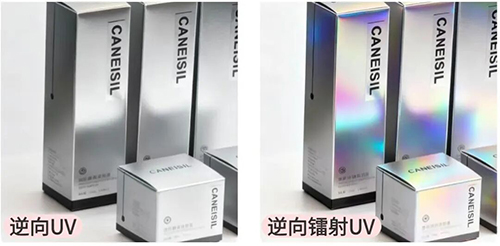
Applications: Cosmetic packaging, cultural and creative merchandise
Common Features: Produced via reverse varnishing technology. Base ink is printed first, followed by partial UV coating. After curing, a striking contrast between matte and glossy areas forms. For holographic variants, a special holographic film is transferred onto the substrate for dramatic visual effects.
Core Advantages: Partial varnishing creates sharp contrast between matte base backgrounds and glossy graphics. Reverse holographic UV delivers iridescent shifting reflections with strong visual appeal from all viewing angles.
▶ Under-print UV (Base-layer Graphic UV)
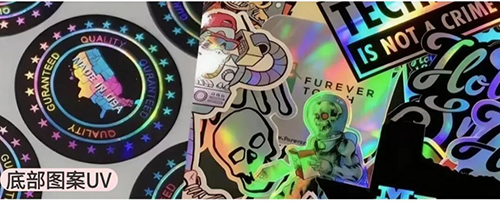
Applications: Cultural merchandise, customized creative gifts
Process Characteristics: Reverse printing sequence: UV coating is applied first, then graphics are overprinted on top. The UV underlayer adds luster and depth, ideal for niche artistic designs.
Advantages: The hidden UV base amplifies the three-dimensionality and layering of graphics, with a subtle raised tactile finish for understated premium texture.
▶ 100-Mesh Screen Printing UV
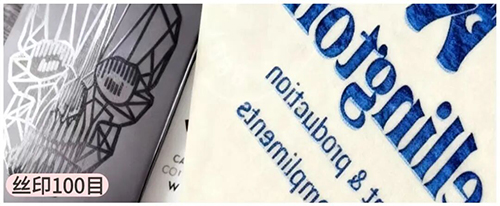
Applications: Large-area graphics, oversized format printing
Process Characteristics: Uses a coarse 100-mesh screen that allows thick ink deposition to create a pronounced raised texture. Suited for bold, heavy-texture designs; not recommended for intricate fine details.
Advantages: Large screen openings yield thick ink layers with exceptional coverage, high color saturation and powerful visual impact. The print is abrasion-resistant, colorfast and durable for outdoor applications.
Comparison Note: Lower mesh count = coarser screen; larger openings deposit more ink, resulting in a rougher printed finish.
▶ 300-Mesh Screen Printing UV
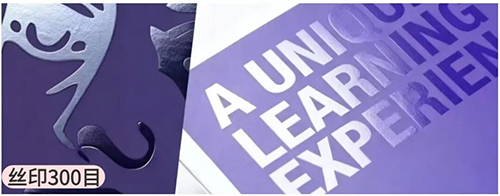
Applications: Smooth substrates, intricate fine-line graphics
Process Characteristics: The fine 300-mesh screen precisely regulates ink flow to prevent overflow or blurring. It is the top UV screen printing choice for designs requiring both texture and minute details.
Advantages: Tiny screen apertures deliver thin, uniform ink layers with high printing resolution. Crisp, clean edges accurately reproduce small text and complex ornate patterns.
Comparison Note: Higher mesh count = finer screen; smaller openings deposit minimal ink for sharp, refined graphics.
▶ Full-Flood UV Coating
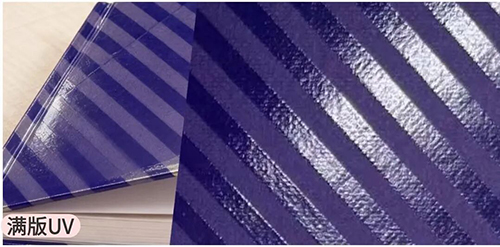
Applications: Hardcover art books, premium gift boxes
Process Characteristics: Uniform all-over surface varnishing with zero skipped areas or color inconsistency. Fast curing enables mass production and instantly elevates product grade.
Advantages: Complete UV coverage delivers consistent, rich gloss that brightens printed colors. It also provides scratch, abrasion and stain resistance to extend product service life.
Selection Guide & Common Pitfall Tips
Selection Recommendations
Premium matte-gloss contrast → Reverse UV
Iridescent shifting rainbow effects → Reverse holographic UV
Large surfaces with bold heavy texture → 100-mesh screen UV
Tiny text / elaborate fine patterns → 300-mesh screen UV
All-over gloss enhancement + scratch protection → Full-flood UV
Creative layered dimensional look → Under-print UV
Pitfall Warnings
Avoid 100-mesh screen printing for small text; edges will blur and fine details will be lost.
Reverse UV performs poorly over large continuous areas, which dulls its signature contrast effect.
Verify lamination compatibility before full-flood UV application, as mismatched films cause edge lifting and warping.
行业术语注释(印刷外贸通用)
UV coating:UV 光油 / UV 工艺
Reverse UV:逆向 UV
Reverse holographic UV:逆向镭射 UV
Mesh:目数(丝网印刷单位)
Full-flood UV:满版 UV
Substrate:承印物 / 包装基材
Curing:UV 固化干燥
Abrasion-resistant:耐摩擦
Lamination:覆膜